
From completion to consequence
When the surface area was mostly editors and pull requests, the failure modes were familiar: style nitpicks, wrong imports, tests that never ran. As soon as an agent can open tickets, tweak infrastructure, or touch customer data, the cost model changes. The question stops being "did it write decent TypeScript?" and becomes "did it know which system it was holding?"
That shift rewards platforms that treat context and permission as first-class—not bolt-on prompts pasted into a chat box.
Fragmentation taxes humans—and models
Cloud-native teams already juggle clusters, pipelines, observability stores, access brokers, and ad hoc spreadsheets. Each silo holds a slice of truth: who owns a service, what depends on what, which changes are in flight. People bridge the gaps with meetings and muscle memory.
A model has no muscle memory. If ownership, topology, and policy live in disconnected systems—or worse, only in someone's head—automation will either refuse to act or improvise dangerously. The bottleneck is rarely raw model quality; it is missing, stale, or inconsistent ground truth.
Four vertices—and the one teams skip
Most agent stacks today name three vertices clearly: prompt (how you ask), context (what the model sees), and tools (what it can invoke). Those are the layers that demo well—sharper instructions, bigger retrieval, MCP wired to production APIs.
The fourth vertex is governance: a policy layer that evaluates intent before execution, applies the same rules regardless of channel, and leaves evidence an auditor can use. Without it, context-rich agents still break prod, and tool-heavy agents become shadow automation with admin keys.
Prompt
Instructions, format, refusal boundaries—optimizes how the model uses what it already has.
Context
Live estate truth—owners, dependencies, incidents, policy notes—not a one-off scrape into a vector store.
Tools
Constrained execution paths with scoped identity and auditable side effects.
Governance
Policy gates, approvals, dry-runs, and execution records—the harness that decides whether an action may run at all. See prompt, context, and harness engineering for how this outer shell fits the full stack.
Context without governance is a confident hallucination with credentials. Tools without governance are faster ways to bypass the controls humans already rely on.
What has to exist before you trust a loop
Useful autonomy needs three things working together: a durable picture of the estate (services, dependencies, environments), rules that say who may change what under which approvals, and a record humans can audit when something misfires. Skip any leg of that tripod and you get either paralysis or shadow IT with a prettier UI.
The middle leg—rules—is where most teams stall. They have RBAC on an API, OPA on deploy, or "we log MCP tool calls," and call it governance. A real policy layer is different: it sits between proposal and execution, blocks or routes for approval with a structured reason, and does not fork because the actor typed in Cursor instead of clicking in a console.
What teams say they have vs. what they need
- "The model has safety training" — not the same as evaluating a specific restart, scale, or data touch against freeze windows and blast-radius tiers before any API runs.
- "We log tool calls" — logging after the fact is not a gate. Auditors and postmortems need who requested, who approved, what executed, and why it was allowed.
- "Prod deploys need approval in GitHub" — operational actions outside the pipeline—incident mitigations, secret rotation, cache flushes—need the same class of control when an agent proposes them.
- "The IDE path is experimental" — if MCP can reach production with broader credentials than the dashboard, policy has already forked by channel.
The maturity tell is simple: can an agent propose a production change and hit the same policy engine as a human clicking the same button—with a record that satisfies an auditor? If not, governance is still a TODO behind a nicer chat UI.
How a policy gate actually runs
Guardrails are not a longer system prompt. They are runtime software—the same discipline platform teams already apply to humans: freeze checks, RBAC, separation of duties, dry-run modes, and evidence on every allowed change.
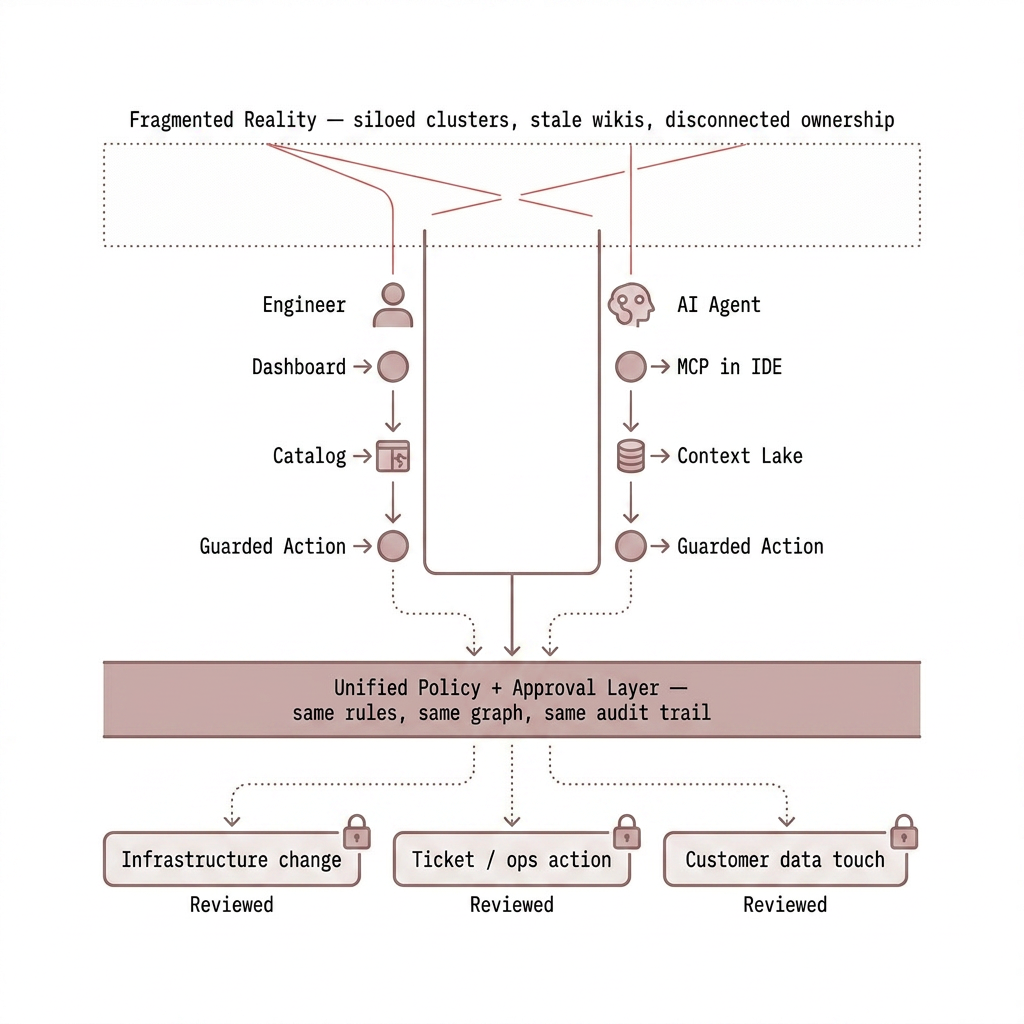
Agent proposes action → policy evaluates (active incident, environment tier, residency, time window) → approval if required → dry-run or scoped execution → apply with audit—or block with a structured reason at any step. Rewriting the prompt does not substitute for a missing approval gate.
That loop is why actor convergence matters: engineers via dashboard and catalog, agents via MCP in the IDE, both through guarded actions into one policy layer—not parallel paths where only one side is reviewed.
How we approach it at Exemplar
Exemplar is built around a single operational layer: catalog and integrations feed a Context Lake so questions and actions draw on the same graph-backed reality your teams maintain—not a one-off RAG dump. DevX Assist exposes the same capabilities you get in the product to conversational surfaces and to MCP in the IDE, so policy does not fork by channel.
Shared substrate
Catalog, integrations, and context so agents and engineers reason over one map of services and dependencies—not parallel fictions.
Governed change
Policy and approvals apply whether a human clicks a button or an agent proposes an action—so "fast" does not mean "unreviewed."
Same tools everywhere
Dashboard, chat-style assistant, and MCP clients invoke the same guarded actions—reducing the class of bugs where the IDE can do something the console would have blocked.
The bar we are aiming for
The end state is not replacing engineers; it is removing swivel-chair work that machines can do safely when grounded in live context and explicit boundaries. Getting there is less about a hotter model and more about boring platform hygiene—shared estate truth, a policy layer that does not fork by channel, audit evidence that survives an incident call—then letting automation ride on top without improvising its own facts.
Teams climbing from code-completion assistants to operational agents are discovering the same ordering: invest in context until answers stop hallucinating, wire tools until the agent can act, then make governance the outer shell so probabilistic output becomes software your org can stand behind. The fourth vertex is not a compliance checkbox—it is the difference between a demo and production.
Editorial—general discussion only.